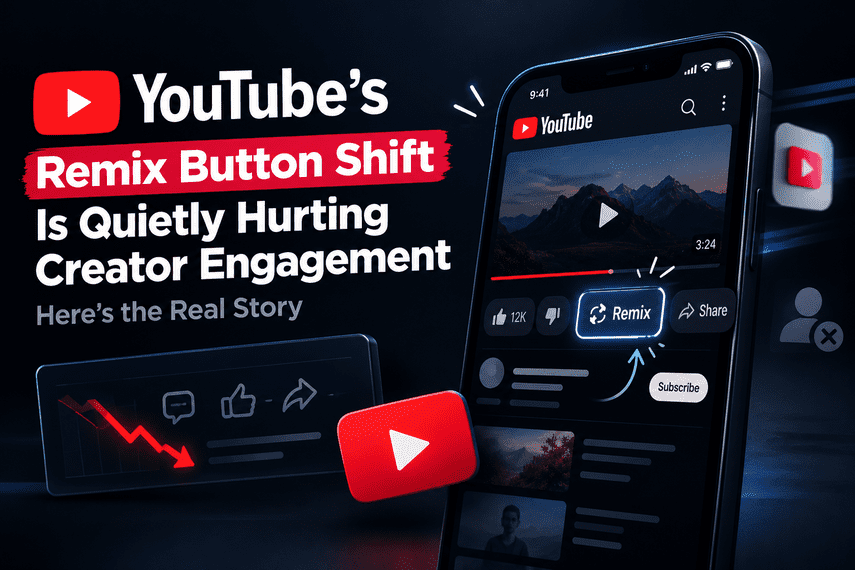
Have you noticed something feels a little quieter on YouTube Shorts lately? Maybe your remix-driven content isn’t getting as many responses as before. Maybe the chain reactions you used to see on trending videos have slowed down a bit. If you’ve been feeling this and couldn’t put your finger on why there’s a good chance the answer is a small interface change that most people completely missed.
YouTube moved the Remix shortcut. What used to be a visible, one-tap button sitting right below the video player is now tucked away inside the Share menu. Two taps instead of one. Sounds tiny, right? But in the world of short-form content, that single extra step is having a real, measurable impact on how many remixes actually get created and by extension, on user engagement across the platform.
Let’s talk about what’s happening, why it matters, and what you as a creator in India can actually do about it.
What Exactly Happened to the Remix Button?
Before September 2026, when you were watching a YouTube Short, the Remix button was sitting right there in plain sight below the player, next to Like, Comment, and Share. One tap and you were inside the Remix editor. No hunting, no menu diving.
YouTube moved that button into the Share menu as part of a broader interface cleanup. The idea was to reduce the number of visible buttons under the player and give viewers a cleaner, simpler screen. If you want to remix now, you tap Share first, then find Remix inside that expanded menu.
The feature itself hasn’t changed at all. Green Screen, Cut, Sound Remix, Collab, React all the remix tools are still there and still working fine. The only thing that changed is how you get to them.
But that “how” matters enormously. And the data is starting to show it.
Remix Moved Out From Under the Player: A Hidden Button Is a Shrinking Format
Here’s the core problem with what YouTube did, and it’s worth understanding this properly because the same logic applies to almost any platform feature.
Most feature usage on any app doesn’t come from people who already know about it and intentionally go looking for it. It comes from people who stumble upon it. They see a button, get curious, tap it, discover something fun, and then it becomes part of how they use the app.
That’s exactly how Remix worked before. Viewer scrolling through Shorts, sees the Remix button, thinks “what’s this?” taps it, creates a short reaction or green screen video, and suddenly they’re a participant instead of just a watcher. That accidental discovery loop was creating remixes by the millions.
Now that the button is inside the Share menu, that loop is broken. The only people finding and using Remix are those who already know it exists and specifically look for it. New users, casual viewers, people who would have tapped out of curiosity they won’t find it. And when you stop getting new people into a feature, usage doesn’t just plateau. It slowly declines, because the existing user base doesn’t grow while the habit naturally fades for some portion of them over time.
This is visible in remix upload trends. Creator communities have noted a noticeable dip in response videos and remix chains since the button moved. Trends that used to generate hundreds of remixed responses are now generating fewer. The same viral loop that made challenges and duet-style content explode on Shorts has become harder to sustain.
Why a Button’s Position Decides a Feature’s Fate
You might be thinking okay, it’s just two taps, why is everyone making such a big deal about this?
Because on short-form video platforms, friction is everything. The entire design philosophy of YouTube Shorts, TikTok, Instagram Reels it’s all built around reducing every possible moment of hesitation. Autoplay removes the effort of choosing the next video. Pre-filled captions reduce the effort of writing. One-tap sharing reduces the effort of distributing.
Every extra tap in the user journey is a moment where someone might think “eh, forget it” and keep scrolling instead. On a platform where the average viewing session involves swiping past dozens of videos in minutes, the difference between one tap and two taps is not small. It genuinely changes how many people complete that action.
YouTube’s own internal data would confirm this which is probably part of why the Remix button was moved in the first place. If YouTube noticed that a large number of remix attempts were accidental or low-quality, reducing the spontaneous tap-through would reduce “noise” in the remix ecosystem. That’s a plausible reason for the move. But it comes at the cost of volume and for creators who depend on remix volume for virality, that cost is real.
Who Is Actually Affected And How Much?
The impact is not equal for everyone. It depends heavily on what role Remix played in your content strategy.
For creators who built their distribution model around other people remixing their content think challenge videos, reaction bait content, music Shorts where people lip sync or dance the impact is direct and significant. Fewer remixes means fewer derivative videos pointing back to your original content. Fewer derivative videos means less discovery traffic flowing toward your channel from remix chains.
For creators who were actively participating in remix trends responding to other creators’ videos, creating collab remixes, building community through back-and-forth content the barrier is now slightly higher for everyone in that ecosystem. The chain shortens because each link requires more deliberate effort.
For creators who make entirely original Shorts and don’t use Remix as a distribution strategy at all, the impact is minimal. Your workflow doesn’t change. Your content strategy doesn’t need to adapt. This is just useful context for understanding platform direction.
The honest reality for most Indian creators is somewhere in the middle. Remix wasn’t necessarily a primary strategy, but it was a secondary driver that added engagement and occasionally pushed a video into a wider loop of responses. Losing that secondary driver quietly reduces reach without it being obvious why engagement numbers dipped.
What This Signals About YouTube’s Priorities for Creators
There’s a bigger picture worth paying attention to here, especially if you’re thinking strategically about your YouTube growth in 2026.
YouTube is clearly moving in a direction where it wants creation to happen through its own tools inside the app, using the editor, with AI-assisted features. The Shorts editor has gotten more capable, with new AI tools and better in-app creation options. YouTube’s investment in this direction is obvious.
Moving Remix into a less visible place, while simultaneously promoting in-app AI editing tools more prominently, tells you something: YouTube values structured, editor-driven creation more than spontaneous, viewer-triggered remixes.
This matters for Indian creators for a specific reason. India is one of YouTube’s largest markets, and Indian viewers skew heavily toward mobile which means in-app creation tools are especially relevant here. If YouTube is betting on assisted in-app creation as the future of Shorts, Indian creators who learn and adopt those tools early will be better positioned than those who continue to rely on older, organic remix mechanics.
For Creators: How to Adapt Your Strategy Right Now
The worst thing you can do is simply notice the dip in remix engagement and not adjust. Here’s what actually helps.
The most immediate fix is education. Tell your audience where the button is now. Seriously a simple verbal or text callout in your video, “Tap Share, then Remix to make your version,” works remarkably well. Discovery is the main problem, not willingness. When you solve the discovery problem manually, you recover a meaningful portion of the lost remix activity.
Beyond that, think about how you can create remix-worthy content more intentionally. If you used to publish a video and trust the Remix button to naturally convert curious viewers into participants, that passive conversion is now weaker. You need to make the remix invitation more explicit through your script, your on-screen text, your call to action, or your community posts.
Another approach that works well for Indian creators is community-driven remix challenges. Instead of relying on organic platform discovery, you announce a remix challenge directly to your community on WhatsApp, on Instagram, in your channel’s Community tab. You give clear instructions, show people exactly how to find the Remix option, and create a specific window of participation. This takes more effort than relying on a visible button, but it produces more engaged, higher-quality remixes.
And on a broader level, this is a good moment to think about how much of your content strategy depends on any single platform feature or button being visible. Features change. Platforms restructure their UI regularly. The creators who adapt fastest are the ones who have built genuine community relationships because those relationships don’t disappear when an interface updates.
This is also where having a solid video promotion service strategy matters more than ever. When organic virality mechanisms like remix chains become less reliable, paid and strategic promotion becomes a stronger pillar. Getting your content directly in front of the right audience people who will engage, share, and come back becomes more valuable when the passive discovery loops weaken.
At NexTech Ads India, working from Kolkata, we help creators across India build that kind of targeted, strategic reach. Whether you’re trying to compensate for lower organic remix engagement or looking to grow your channel more systematically, a proper video promotion service can fill gaps that platform changes create. Visit nextechads.in to learn more about how we work with creators.
What YouTube’s CEO Has Said About Shorts in 2026
It’s worth noting the broader context that Neal Mohan, YouTube’s CEO, laid out for Shorts this year. The overall direction is expansion more features, better tools, more integration with the main YouTube experience. Shorts is being treated as a serious long-term priority, not just a temporary response to short-form competition.
That’s genuinely good news for creators who are investing in Shorts as a content format. YouTube isn’t abandoning Shorts if anything, they’re doubling down. The Remix button move is one small piece of a much larger redesign effort that aims to make the overall Shorts experience cleaner and more powerful.
The new playback controls for Shorts, the addition of a direct Shorts tab on the web browser, the cleaner Share menu all of these are part of the same UX refresh. YouTube is trying to make Shorts feel more polished and intentional, less chaotic.
So while the Remix button change has had a real short-term impact on remix engagement, it’s part of a platform that is overall investing more in Shorts, not less. Creators who understand this and adjust their strategies accordingly will benefit from that investment over the long term.
FAQ: YouTube Remix Button and Engagement Impact
Why did YouTube move the Remix button?
YouTube moved it as part of a broader interface simplification, aiming to reduce the number of buttons visible below the video player and give viewers a cleaner screen. The official reason is UI simplification. The practical effect is that Remix is now less discoverable.
Has the Remix feature been removed?
No. Remix and all its tools Green Screen, Cut, Sound Remix, Collab, React are still fully functional. They’re now accessed through Share → Remix instead of a dedicated button below the player.
Why are fewer remixes being created since the button moved?
Because the main driver of remix creation was accidental discovery. When the button was visible, curious viewers tapped it and discovered the feature. With the button inside a menu, that casual discovery loop no longer happens, so overall remix volume has declined.
What can I do to keep remix engagement going on my channel?
Tell your audience explicitly how to find the Remix option. Add it to your call to action at the end of videos. Run structured remix challenges through your community rather than relying on passive button discovery. Consider promoting your content more actively to maintain overall engagement levels.
Does this affect all Indian creators equally?
No. Creators who relied heavily on viewer-generated remixes as a distribution strategy are most affected. Creators who make independent Shorts without depending on remix chains are much less affected.
Is YouTube investing in Shorts despite this change?
Yes, very much so. YouTube’s 2026 Shorts updates include new features, better tools, and expanded platform integration. The Remix button move is a small UX change within a much larger program of Shorts improvement.
Small changes on big platforms can have surprisingly big effects. The Remix button moving from a visible spot below the player into the Share menu is exactly that kind of change easy to miss, but meaningful in its impact on how content spreads and how engagement builds.
The creators who notice this, understand why it happened, and adapt their strategy accordingly will keep growing. The ones who don’t may find their engagement numbers quietly drifting without knowing why.
Stay informed, stay adaptable, and keep creating for your audience.